Squats are one of the most useful movements for building strength. They help you get out of a chair, climb stairs, lift objects, play sport, and train in the gym.
But what happens when squatting starts to hurt your knees?
Perhaps you feel pain at the front of your knee when lowering yourself. Maybe your knee aches when you reach the bottom of a squat, or you notice discomfort when standing back up. You might even feel fine during everyday activities but experience pain when lifting weights.
The important question is: what is your knee pain actually telling you?
Knee pain during squatting does not automatically mean you have damaged your cartilage, worn out your knees, or developed arthritis. Several different conditions can cause similar symptoms, and the location of your pain, your training history, and how your knee responds to load can all provide useful clues.
At Narrow Gate Physiotherapy in Belmore, NSW, we believe the first step is to understand why your knee hurts before deciding what to do about it.
In this article, we explain the most common causes of knee pain during squats, what different pain patterns may indicate, and how physiotherapy can help you return to training with greater confidence.
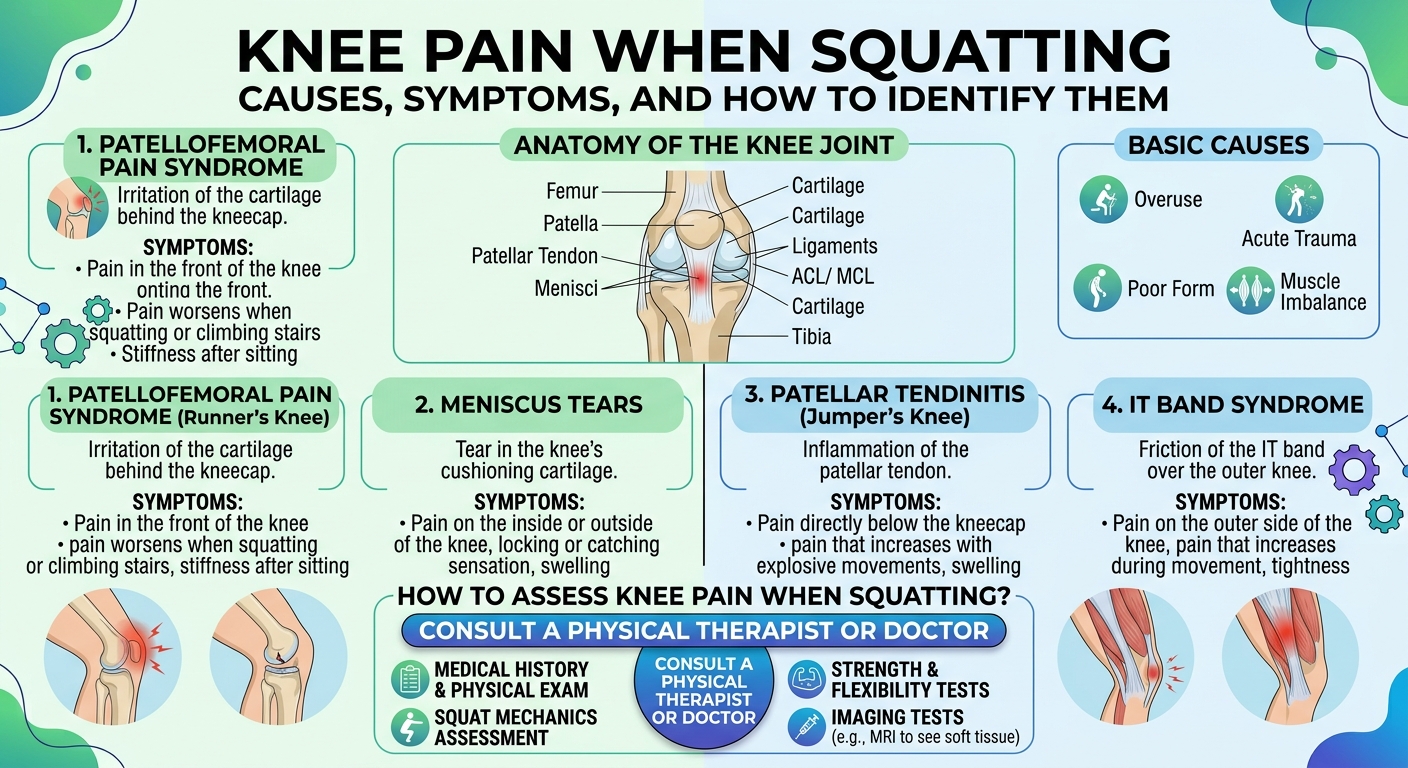
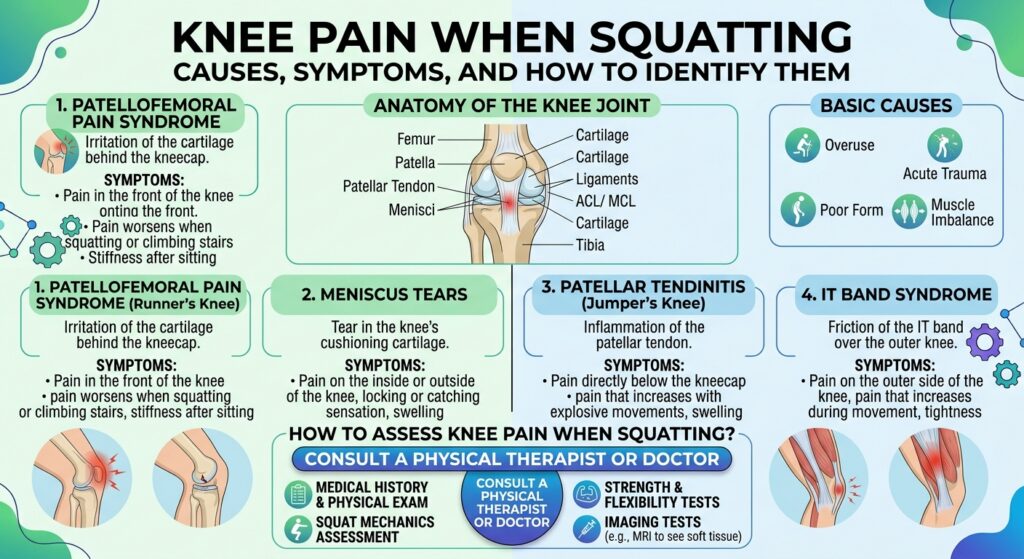
1. Patellofemoral Pain: Pain Around or Behind the Kneecap
One of the common causes of knee pain during squatting is patellofemoral pain.
The patellofemoral joint is where your kneecap, or patella, meets your thigh bone. This joint helps transfer forces through the knee as you bend and straighten your leg.
When the demands placed on the knee exceed what it currently tolerates, pain can develop around or behind the kneecap.
What does it feel like?
You may notice:
- Pain at the front of the knee during squats.
- Discomfort when climbing or descending stairs.
- Pain when walking downhill.
- Knee discomfort after prolonged sitting with your knees bent.
- Pain during lunges, running, jumping, or other loaded knee movements.
For example, you may be able to walk around comfortably but experience pain when performing repeated squats or descending a flight of stairs.
Why does it happen?
Patellofemoral pain can be influenced by several factors, including:
- A sudden increase in training volume or intensity.
- Repeated deep squats or lunges beyond your current tolerance.
- Reduced strength or capacity in the muscles around the hip and knee.
- Changes in training frequency or recovery.
- Previous knee pain or injury.
It is not necessarily caused by your kneecap being out of alignment. The underlying factors can differ between individuals.
What can help?
Management often involves temporarily adjusting painful activities while gradually improving your knee’s capacity to tolerate loading.
Depending on your assessment, rehabilitation may include quadriceps strengthening, hip strengthening, progressive squat variations, and a gradual return to your usual training volume.
The goal is not to avoid squats forever. It is to find a manageable starting point and build from there.
2. Patellar Tendinopathy: Pain Just Below the Kneecap
The patellar tendon connects the kneecap to the shin bone. It plays an important role when you straighten your knee, jump, land, accelerate, and change direction.
Patellar tendinopathy is a condition involving pain and reduced load tolerance in this tendon. It is common in sports that involve repeated jumping and explosive movements, although it can also affect people who perform demanding gym programmes.
What does it feel like?
Typical symptoms may include:
- Localised pain just below the kneecap.
- Discomfort during squats, especially when the load is high.
- Pain during jumping or landing.
- Tenderness over the patellar tendon.
- Symptoms that increase when training volume or intensity rises.
You might notice pain during heavy squats, jumping exercises, or basketball sessions, particularly after increasing your workload.
Why does it happen?
Tendons adapt to the loads placed on them, but their capacity does not always keep pace with sudden changes in training.
For example, if you significantly increase your squat weight, add jumping exercises, and train more frequently within a short period, your patellar tendon may struggle to tolerate the increased demand.
This does not mean exercise is inherently damaging. It means your training progression may need to better match your current capacity.
What can help?
Patellar tendinopathy often benefits from a structured loading programme.
Depending on your symptoms, this may begin with tolerable strengthening exercises before progressing towards heavier resistance, jumping, and sport-specific activity.
Complete rest may reduce symptoms temporarily, but returning to the same workload without rebuilding capacity can lead to recurring problems.
A physiotherapist can help determine an appropriate loading progression based on your pain, strength, and training goals.
3. Knee Osteoarthritis: Pain, Stiffness, and Reduced Tolerance
Osteoarthritis involves changes in the joint cartilage and other joint tissues. It becomes more common with age and may also develop following previous knee injuries.
Some people with knee osteoarthritis experience pain during squats because the movement places substantial demands on the knee joint.
However, knee pain does not automatically mean you have arthritis, and an arthritis diagnosis does not mean you must stop squatting.
What does it feel like?
Possible symptoms include:
- Knee pain during squatting or standing up from a chair.
- Stiffness after sitting or resting.
- Discomfort when climbing stairs.
- Reduced tolerance for prolonged walking or standing.
- Swelling or a feeling that the knee is less flexible.
- Symptoms that fluctuate depending on your activity levels.
Some people experience more discomfort at the beginning of movement, while others notice symptoms after a longer period of activity.
Why does it happen?
Osteoarthritis can involve changes to several structures within the knee. Symptoms are influenced by more than what appears on an X-ray.
Previous injury, age, strength, activity levels, and other individual factors may contribute to how the condition affects you.
What can help?
Exercise is an important part of managing many cases of knee osteoarthritis.
A suitable programme may include strengthening the quadriceps and hip muscles, improving overall physical capacity, and gradually increasing your tolerance for squats and other functional movements.
The depth and resistance of your squat can be adjusted to suit your current symptoms.
Avoiding all knee-loading exercise may unnecessarily reduce your strength and capacity. The goal is to find a level of activity you can manage and progress appropriately.
4. Meniscus Injury: Pain After Twisting or Deep Bending
The menisci are two pieces of specialised cartilage inside the knee that help distribute load and contribute to joint function.
A meniscus injury can occur during a twisting movement, particularly when the foot is planted and the knee rotates. Meniscal changes can also develop gradually over time.
What does it feel like?
Depending on the injury, symptoms may include:
- Pain along the inner or outer joint line.
- Pain during deep squats.
- Swelling after an injury.
- Discomfort when twisting or turning.
- Catching sensations or difficulty fully straightening the knee.
A traumatic meniscus injury may occur during sport, while age-related meniscal changes may develop without one obvious incident.
How can you recognise it?
Pain during deep squatting alone does not confirm a meniscus tear.
A history of twisting, swelling, joint-line pain, and mechanical symptoms may help guide the assessment. Your physiotherapist or doctor will also consider other possible causes.
If your knee becomes genuinely locked and you cannot fully straighten it, seek prompt medical assessment.
What can help?
Management depends on the nature and severity of the injury, your symptoms, and your activity goals.
Some meniscal injuries can be managed with rehabilitation, including progressive strengthening and activity modification. Others may require medical or orthopaedic assessment.
An MRI is not automatically necessary for every person with knee pain. Imaging may be appropriate when the clinical findings suggest a significant injury or when the result would change treatment decisions.
5. Quadriceps Weakness or Reduced Knee Capacity
Sometimes knee pain develops because your current physical capacity is not sufficient for the demands you are placing on it.
This does not mean your muscles are necessarily weak in an absolute sense. They may simply lack the strength, endurance, or training tolerance required for your current activities.
What does it feel like?
You may notice:
- Knee discomfort when repeatedly squatting.
- Difficulty controlling the lowering phase.
- Fatigue during sets of squats or lunges.
- Difficulty rising from a low chair.
- Reduced confidence when loading the affected leg.
These symptoms can occur for many reasons, so muscle weakness should not be assumed to be the only cause.
Why does it happen?
Consider someone who has spent several months exercising very little before returning to heavy gym training.
Their motivation may have returned faster than their physical capacity.
Even if they previously performed heavy squats comfortably, their current strength and tolerance may have changed.
A similar situation can occur after injury, surgery, illness, or a prolonged period of reduced activity.
What can help?
An appropriate rehabilitation programme may involve gradually rebuilding quadriceps strength, hip strength, movement control, and overall exercise tolerance.
Starting with a manageable resistance and progressing systematically is often more productive than repeatedly testing how much weight your knee can tolerate.
The aim is to make your body better prepared for the demands you want it to handle.
6. Training Load: When You Are Doing More Than Your Knee Can Tolerate
Not every painful knee has a single identifiable structural injury.
Sometimes the most important factor is a mismatch between your current capacity and the amount of activity you are performing.
This is particularly relevant for people who increase their training quickly or combine several demanding activities.
What does it feel like?
You may notice:
- Knee pain beginning after increasing squat weight.
- Symptoms following a sudden increase in running distance.
- Discomfort after adding more training sessions.
- Pain that increases as your workout progresses.
- Symptoms that settle with reduced activity but return when you resume the same workload.
For example, you may increase your squat weight, add lunges, begin running again, and play sport on the weekend. Each activity may be reasonable individually, but the combined workload may exceed your current tolerance.
What can help?
Start by reviewing the overall workload rather than automatically blaming your squat technique.
You may need to adjust one or more variables, such as:
- Weight lifted.
- Number of repetitions or sets.
- Squat depth.
- Training frequency.
- Running or jumping volume.
- Recovery time between sessions.
You can often continue some form of exercise while modifying the activities that provoke significant symptoms.
A useful rehabilitation plan helps you identify a tolerable starting point, monitor your response, and increase your workload progressively.
7. Is Your Squat Technique Causing Your Knee Pain?
When knee pain occurs during squats, many people immediately assume that their technique is wrong.
They may be told that their knees should never travel past their toes, that their feet must point straight ahead, or that their knees must remain in one exact position throughout the movement.
However, there is no single squat technique that suits every person and every purpose.
Knee position, trunk angle, stance width, and squat depth naturally vary with body proportions, mobility, load, and training goals.
Knees moving forward over the toes is not automatically dangerous. In many squat variations, this is a normal part of the movement.
What should you consider instead?
If squatting hurts, consider the following questions:
- Did you recently increase the weight or number of repetitions?
- Does the pain occur only at a particular depth?
- Does reducing the load make the movement more comfortable?
- Are you able to control the movement comfortably?
- Does your knee remain more painful later that day or the following morning?
- Have you recently changed your training frequency or added another activity?
Technique may be relevant, particularly if a movement variation places demands on your knee that you currently struggle to tolerate.
However, the goal is not to achieve a perfect-looking squat. It is to find a movement pattern that suits your body, training goals, and current capacity.
A physiotherapist can assess your squat and help determine whether changes to technique, loading, or rehabilitation are appropriate.
8. How to Modify Squats When Your Knee Hurts
If your knee hurts during squatting, you may not need to stop all lower-body training.
The right modification depends on the cause and severity of your symptoms. For uncomplicated knee pain, the following options may help you find a more manageable starting point.
Option 1: Reduce the depth
If your knee hurts near the bottom of a deep squat, try a shallower range that you can perform more comfortably.
You can gradually increase the depth as your tolerance improves.
Option 2: Reduce the resistance
If you usually perform weighted squats, temporarily reduce the weight or use a bodyweight variation.
The goal is to maintain movement and training where appropriate without repeatedly provoking significant symptoms.
Option 3: Reduce your total training volume
Consider reducing the number of sets, repetitions, or sessions temporarily.
Sometimes the problem is not one individual squat but the total amount of work accumulated over several days.
Option 4: Explore other exercises
Depending on your symptoms, alternatives may include sit-to-stand exercises, supported squats, controlled step-ups, or other strengthening movements.
No exercise is universally appropriate for every knee condition. Choose movements that match your assessment and current tolerance.
Option 5: Monitor your response
Pay attention to what happens during the exercise, after the session, and the following day.
If symptoms consistently worsen or your knee becomes increasingly swollen, the programme may need to be adjusted and your condition assessed.
These suggestions are not a substitute for assessment if your pain is severe, follows a significant injury, or is accompanied by concerning symptoms.
9. When Should You Seek Medical Assessment?
Many cases of knee pain can be assessed routinely, but certain symptoms require more urgent attention.
Seek urgent medical assessment if:
- Your knee becomes very swollen soon after a significant injury.
- You cannot bear weight or move your knee following an injury.
- Your knee is visibly deformed.
- Your knee becomes locked and cannot fully straighten.
- Your knee is hot, red, and swollen, particularly if you also have a fever.
- You develop significant calf swelling or pain, especially with shortness of breath or chest pain.
A prompt assessment is also appropriate if your pain persists, repeatedly returns, or progressively limits your daily activities.
The purpose of an assessment is to identify the likely cause, determine whether imaging or medical review is needed, and develop an appropriate management plan.
10. How Narrow Gate Physiotherapy Can Help
At Narrow Gate Physiotherapy in Belmore, NSW, we understand that knee pain can interfere with much more than your gym routine.
It can affect your ability to work, climb stairs, play sport, care for your family, and maintain an active lifestyle.
Our approach focuses on understanding your symptoms and physical demands before deciding which treatment is appropriate.
Step 1: Assess your knee
We explore your symptoms, injury history, training routine, and functional limitations. Depending on your presentation, the assessment may include knee movement, strength, balance, and relevant functional tests.
We also consider whether your symptoms suggest a need for medical review or further investigation.
Step 2: Identify the relevant factors
Your pain may relate to a specific injury, reduced strength, changes in training load, or several contributing factors.
We aim to explain the findings clearly so you understand why your knee may be struggling with particular activities.
Step 3: Develop a suitable rehabilitation plan
Your exercises should reflect your current capacity and goals.
For one person, this may involve gradually returning to deep squats. For another, it may mean rebuilding strength after an injury or improving tolerance for running and jumping.
Step 4: Progress your training
As your symptoms and capacity improve, we help you increase the demands placed on your knee in a structured way.
This may include increasing resistance, squat depth, training volume, or sport-specific movements when appropriate.
Step 5: Reassess and refine
We monitor your response and adjust the plan if progress stalls or symptoms change.
Our aim is to help you return to meaningful activity with a better understanding of your body and the tools to manage your training.
Get you better. Keep you better. Help you stay better.
That is the principle behind our approach to rehabilitation at Narrow Gate Physiotherapy.
Frequently Asked Questions
Should I stop squatting if my knees hurt?
Not necessarily. The appropriate response depends on the cause and severity of your pain. You may be able to continue with a lighter load, shallower range, or modified exercise. Significant pain, swelling, or symptoms following an injury warrant assessment.
Are squats bad for your knees?
Squats are not inherently bad for your knees. They are a normal movement and can be useful for developing strength and function. Problems can arise when the demands of an activity exceed your current capacity or when an underlying condition affects your tolerance.
Does knee pain mean I have arthritis?
No. Knee pain during squats can arise from several conditions, including patellofemoral pain, tendon problems, meniscal injuries, osteoarthritis, or changes in training load. Symptoms alone cannot reliably establish the diagnosis.
Should my knees go past my toes when squatting?
Your knees can naturally travel past your toes during many squat variations. This is not automatically harmful. The appropriate technique depends on your body, exercise goals, mobility, and current symptoms.
Do I need an MRI for knee pain?
Not always. A clinical assessment can often guide the initial management of knee pain. Imaging may be considered when a significant injury is suspected, symptoms persist, the diagnosis remains uncertain, or the findings would change treatment.
How long does knee pain take to improve?
Recovery varies according to the underlying condition, symptom severity, activity demands, and response to rehabilitation. Some problems improve over several weeks, while tendon injuries, significant joint problems, and other conditions may require longer-term management.
Conclusion: Your Knee Pain Is Information, Not an Automatic Stop Sign
Knee pain during squatting can mean several different things. It may relate to patellofemoral pain, patellar tendinopathy, osteoarthritis, a meniscal injury, reduced physical capacity, or a mismatch between your training load and recovery.
The important step is to understand the likely cause rather than guessing or assuming that your knees are being damaged.
Sometimes the answer involves modifying your squat. Sometimes it involves rebuilding strength, adjusting training load, or investigating a specific injury.
If knee pain is affecting your training, work, or daily activities, a thorough assessment can help you determine the appropriate next step.
You can make a booking online or call us on 0478 260 200. For a limited time, we have free discovery sessions where you get assessed by our physiotherapists and given an outline of how we can help you to have full confidence in working with us. We also offer promotions that include discounted initial sessions to incentivise getting started with your rehabilitation journey.