Introduction
One of the first questions almost every client asks is:
“How many physiotherapy sessions will I need?”
It’s a sensible question.
Whether you’re investing your time, money, or simply trying to plan around work and family commitments, you naturally want to know how long recovery will take.
The honest answer is:
It depends—but probably fewer than you think if rehabilitation is done properly.
At Narrow Gate Physiotherapy, our goal isn’t to keep you coming back indefinitely.
Our goal is to help you recover as efficiently as possible while giving you the knowledge and confidence to manage your health independently.
There Is No “Magic Number”
Every injury is different.
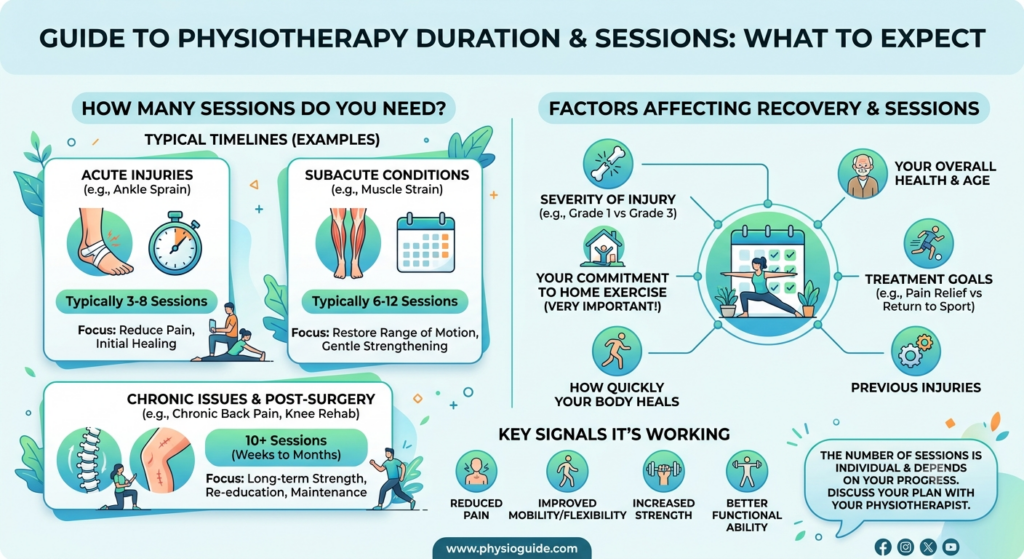
Recovery depends on factors such as:
- The diagnosis
- How long you’ve had the problem
- Your age
- Your overall health
- Your activity level
- Previous injuries
- Your commitment to rehabilitation
- How accurately the problem has been diagnosed
Someone with mild ankle pain may recover in only a few sessions.
Someone recovering from major surgery may require rehabilitation over several months.
This is why quality assessment is so important.
When Should You Start Feeling Better?
Many people begin noticing improvements after the first few sessions.
This doesn’t necessarily mean the injury has healed.
It simply means that:
- Pain is becoming more manageable
- Movement is improving
- Confidence is increasing
- The body is responding positively
Healing and recovery are not always the same thing.
Pain often settles before tissues have fully recovered.
This is why stopping rehabilitation too early is one of the biggest mistakes people make.
A Typical Physiotherapy Journey
Although everyone is different, rehabilitation often follows several stages.
Stage 1: Assessment and Understanding
The first session focuses on understanding:
- What is causing your symptoms?
- Why did the injury occur?
- What factors are slowing recovery?
- What activities need to change?
This stage lays the foundation for everything that follows.
Without a proper assessment, treatment becomes guesswork.
Stage 2: Reducing Pain and Irritation
Once the diagnosis is clear, treatment focuses on:
- Reducing pain
- Improving movement
- Settling irritated tissues
- Educating you about your condition
Many people begin to feel noticeably better during this phase.
Stage 3: Restoring Strength and Function
This is where lasting recovery begins.
Treatment progresses toward:
- Strength
- Mobility
- Balance
- Stability
- Load tolerance
The goal shifts from simply feeling better to becoming more resilient.
Stage 4: Preventing Recurrence
This is the stage many people skip.
Unfortunately, it’s also the stage that prevents future injuries.
At Narrow Gate Physiotherapy we place significant emphasis on:
- Exercise progression
- Load management
- Technique correction
- Long-term planning
Getting rid of pain is only half the job.
Keeping it away is the other half.
How Many Sessions Do Most People Need?
Although there is no universal answer, many uncomplicated musculoskeletal conditions improve within:
Approximately 4–8 physiotherapy sessions
More complex injuries, chronic pain, post-operative rehabilitation or neurological conditions often require additional treatment over a longer period.
The number of visits is less important than achieving the right milestones.
We measure success by:
- Improved function
- Better movement
- Increased strength
- Reduced pain
- Greater confidence
- Long-term independence
Not simply by how many appointments you’ve attended.
Why Some Clinics Recommend More Sessions
Not every physiotherapy clinic operates the same way.
Some models rely heavily on:
- Passive treatments
- Manual therapy
- Frequent maintenance appointments
While these approaches can provide temporary relief, they may not build the strength and resilience needed for lasting improvement.
At Narrow Gate Physiotherapy, we prefer a different philosophy.
We want to teach you:
- Why your injury happened
- How to correct it
- How to manage it yourself
- How to prevent it from returning
The ultimate goal is to reduce your dependence on treatment—not increase it.
Why We Often Need Fewer Sessions
Many clients are surprised that we don’t recommend endless appointments.
That’s because our rehabilitation is built around:
Thorough Assessment
Understanding the problem before treating it.
Education
Helping you understand your condition so you make better decisions between appointments.
Individualised Exercise Prescription
Giving you the right exercises—not just more exercises.
Load Management
Teaching you exactly how much activity your body can currently tolerate.
Progressive Rehabilitation
Building long-term capacity rather than chasing short-term pain relief.
When clients understand what to do outside the clinic, they often recover faster.
The Biggest Determinant of Success Isn’t the Number of Sessions
It’s what happens between sessions.
The clients who recover best usually:
- Complete their exercises consistently
- Follow load management advice
- Ask questions
- Stay active
- Sleep well
- Maintain realistic expectations
Physiotherapy is a partnership.
Your physiotherapist provides the roadmap.
Your daily habits determine how quickly you travel it.
Should You Stop Once the Pain Is Gone?
Not usually.
Pain disappearing does not always mean the injury has fully recovered.
For example:
- Tendons may still be rebuilding strength.
- Muscles may still be weak.
- Movement patterns may still be inefficient.
Stopping rehabilitation too early increases the likelihood of recurrence.
One of our goals is to make sure you’re not only pain-free—but capable of staying pain-free.
Why High Performers Often Recover Faster
Many of our executive and high-performing clients do exceptionally well because they:
- Follow instructions carefully
- Value long-term thinking
- Commit to exercise
- Understand delayed gratification
- Take ownership of their recovery
These qualities often matter more than the injury itself.
How Narrow Gate Physiotherapy Is Different
Our mission isn’t simply to reduce pain.
It’s to create lasting change.
That means helping you:
- Recover efficiently
- Build resilience
- Prevent future injuries
- Become confident managing your own health
If that means fewer appointments, we’ve done our job well.
Success is measured by your independence—not your dependence on us.
Key Takeaways
- Most people begin feeling improvement within the first few physiotherapy sessions.
- Many uncomplicated injuries recover within approximately 4–8 sessions.
- Complex conditions may require longer rehabilitation.
- Pain relief is not the same as complete recovery.
- Long-term success depends more on your commitment than the number of appointments.
- Quality physiotherapy focuses on helping you need fewer sessions—not more.
Conclusion
So, how many physiotherapy sessions do you need?
Enough to:
- Understand your problem.
- Restore normal movement.
- Build strength.
- Improve your confidence.
- Prevent the injury from returning.
At Narrow Gate Physiotherapy, we believe the best physiotherapy isn’t measured by how long you stay with us.
It’s measured by how well you continue without us.
Our aim is simple:
Get you better. Keep you better. Help you stay better.
You can make a booking online or call us on 0478 260 200. For a limited time, we have free discovery sessions where you get assessed by our physiotherapists and given an outline of how we can help you to have full confidence in working with us. We also offer promotions that include discounted initial sessions to incentivise getting started with your rehabilitation journey.