Introduction
A dislocated elbow is a painful injury that usually happens after a fall onto an outstretched hand, during contact sports, or following a traumatic accident.
If you’ve recently dislocated your elbow, you’re probably wondering:
- How long will it take to recover?
- Will I regain full movement?
- Do I need surgery?
- When can I return to work or sport?
The good news is that most simple elbow dislocations recover well with the right medical care and a structured physiotherapy program.
At Narrow Gate Physiotherapy, we help clients safely restore movement, strength, and confidence while reducing the risk of stiffness and future instability.
What Is a Dislocated Elbow?
A dislocated elbow occurs when the bones that make up the elbow joint move out of their normal position.
The elbow consists of three bones:
- The humerus (upper arm)
- The radius (thumb side of the forearm)
- The ulna (little finger side of the forearm)
When a significant force is applied, these bones can separate, causing a dislocation.
There are two main types:
Simple Elbow Dislocation
The bones move out of place without a major fracture.
These injuries usually recover well with appropriate treatment.
Complex Elbow Dislocation
The dislocation occurs alongside one or more fractures or significant ligament injuries.
These cases often require surgery before physiotherapy begins.
What Causes an Elbow Dislocation?
Common causes include:
- Falling onto an outstretched hand
- Contact sports such as rugby or football
- Cycling accidents
- Motor vehicle accidents
- Gymnastics or martial arts injuries
- Workplace falls
Young athletes and active adults are particularly at risk due to higher-impact activities.
Symptoms of a Dislocated Elbow
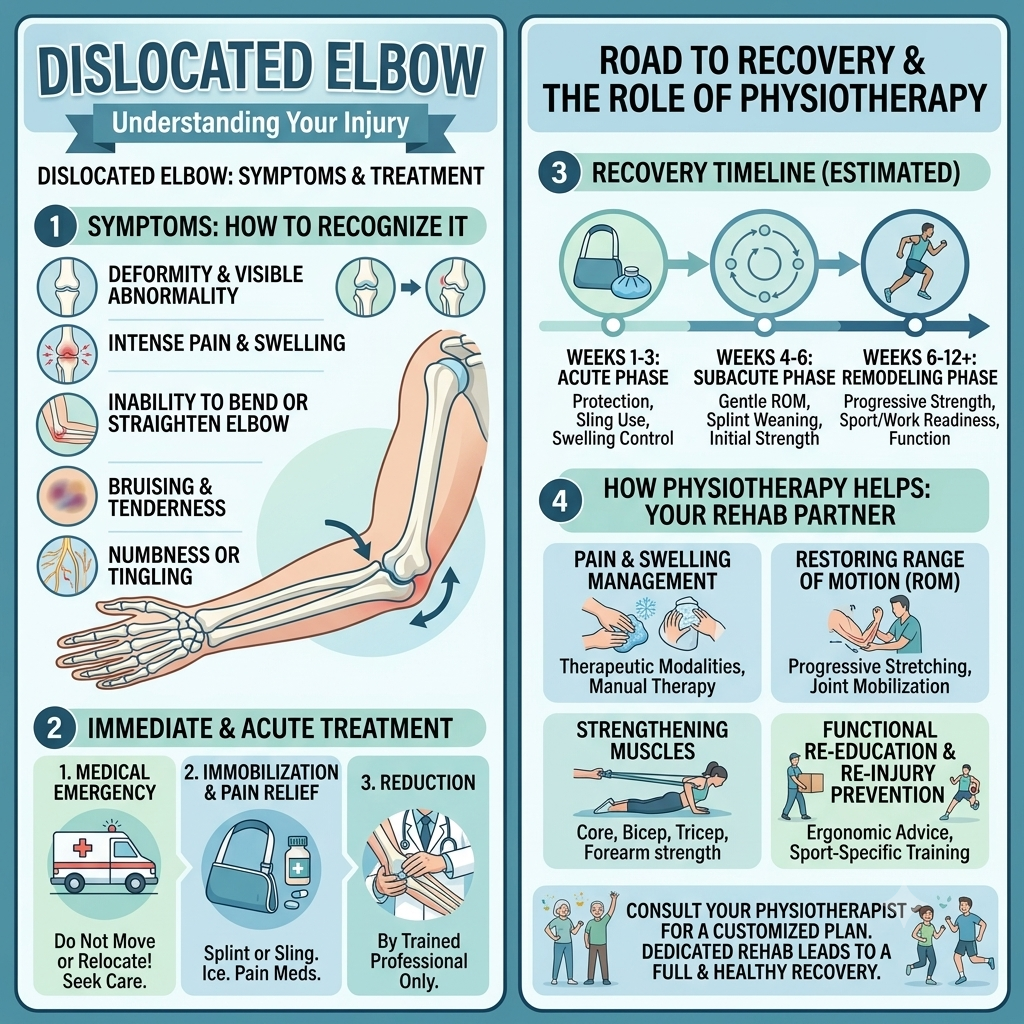
A dislocated elbow usually causes immediate symptoms, including:
- Severe elbow pain
- A visibly deformed elbow
- Rapid swelling
- Inability to move the arm
- Tenderness around the joint
- Bruising
- Numbness or tingling in the hand (if nearby nerves are affected)
If you suspect an elbow dislocation, seek medical attention immediately. Do not attempt to push the elbow back into place yourself.
How Is a Dislocated Elbow Diagnosed?
Your doctor will typically perform:
- A physical examination
- X-rays to confirm the dislocation and rule out fractures
In more complex injuries, additional imaging such as a CT scan or MRI may be required to assess ligament, cartilage, or bone damage.
Treatment for a Dislocated Elbow
Reduction
The first step is relocating the joint back into its correct position.
This procedure is usually performed in an emergency department using pain relief or sedation.
Immobilisation
Following reduction, your elbow may be placed in:
- A sling
- A splint
- A hinged brace
Immobilisation is usually short-term.
Keeping the elbow immobilised for too long significantly increases the risk of stiffness.
Why Physiotherapy Is Essential
One of the biggest complications after an elbow dislocation is loss of movement.
Without appropriate rehabilitation, clients may experience:
- Persistent stiffness
- Weakness
- Instability
- Difficulty lifting objects
- Pain during daily activities
- Reduced sporting performance
Physiotherapy helps restore normal function safely and progressively.
Goals of Physiotherapy
Your rehabilitation program may focus on:
Restoring Range of Motion
Gentle mobility exercises help regain:
- Elbow bending
- Elbow straightening
- Forearm rotation
Movement is introduced gradually to protect healing tissues.
Rebuilding Strength
As healing progresses, strengthening begins for:
- Biceps
- Triceps
- Forearm muscles
- Shoulder muscles
- Grip strength
Strong surrounding muscles improve joint stability.
Improving Joint Stability
After a dislocation, the supporting ligaments may remain stretched.
Specific exercises help retrain:
- Muscle control
- Joint awareness (proprioception)
- Dynamic stability
This reduces the likelihood of another dislocation.
Returning to Everyday Activities
Physiotherapy also prepares you for:
- Driving
- Lifting
- Returning to work
- Household tasks
- Sporting activities
Recovery is based on function—not just time.
Exercises Commonly Used During Rehabilitation
Your physiotherapist will prescribe exercises appropriate for your stage of healing.
Examples may include:
Early Stage
- Assisted elbow bending and straightening
- Gentle forearm rotation
- Wrist and hand exercises
- Grip strengthening
Middle Stage
- Resistance band exercises
- Light dumbbell strengthening
- Shoulder stability exercises
- Functional reaching activities
Late Stage
- Push-up progressions
- Closed-chain stability exercises
- Sport-specific drills
- Plyometric exercises (where appropriate)
Every program is individualised based on your injury and goals.
How Long Does Recovery Take?
Recovery varies depending on the severity of the injury.
As a general guide:
- Simple elbow dislocations often recover within 6–12 weeks
- More complex injuries may take 3–6 months or longer
Returning to high-impact sports may require additional rehabilitation to ensure adequate strength and stability.
Common Mistakes After an Elbow Dislocation
Avoid these common errors:
Keeping the elbow immobilised for too long
Prolonged immobilisation increases stiffness.
Returning to sport too early
Even if pain has improved, the ligaments may still be healing.
Ignoring strength training
Mobility alone is not enough.
Strength is essential for long-term joint stability.
Skipping physiotherapy
Many people regain basic movement but never restore full function because rehabilitation ends too soon.
How Narrow Gate Physiotherapy Can Help
At Narrow Gate Physiotherapy, we provide comprehensive rehabilitation following elbow dislocations.
Our treatment includes:
- Thorough assessment
- Safe progression of mobility
- Individualised strengthening
- Stability retraining
- Functional movement restoration
- Return-to-work planning
- Return-to-sport rehabilitation
Our goal is not simply to restore movement—but to help you regain confidence in using your arm again.
When Should You See a Physiotherapist?
Once your doctor has confirmed the elbow is stable and safe to begin movement, early physiotherapy can help:
- Reduce stiffness
- Improve movement
- Prevent long-term complications
- Speed up functional recovery
The earlier rehabilitation begins (when medically appropriate), the better the long-term outcome is likely to be.
Key Takeaways
- A dislocated elbow is a serious injury that requires prompt medical treatment.
- Most simple elbow dislocations recover well without surgery.
- Physiotherapy is essential for restoring movement, strength, and stability.
- Early, guided rehabilitation helps prevent stiffness and long-term disability.
- Returning to work and sport should be based on function rather than time alone.
Conclusion
A dislocated elbow can feel overwhelming, but with the right treatment and rehabilitation, most people make an excellent recovery.
The key is not just relocating the joint—it is restoring its strength, stability, and function.
At Narrow Gate Physiotherapy, we guide you through every stage of rehabilitation so you can return to work, sport, and everyday life with confidence.
You can make a booking online or call us on 0478 260 200. For a limited time, we have free discovery sessions where you get assessed by our physiotherapists and given an outline of how we can help you to have full confidence in working with us. We also offer promotions that include discounted initial sessions to incentivise getting started with your rehabilitation journey.