Introduction
When most people think about physiotherapy, they think about:
- Massage
- Dry needling
- Joint mobilisation
- Stretching
- Exercise prescription
While these all have their place, one of the most powerful treatments in physiotherapy isn’t a technique at all.
It’s load management.
In fact, regardless of whether you have back pain, shoulder pain, knee pain, tendinopathy, arthritis, sciatica, or are recovering from surgery, your rehabilitation will largely succeed or fail based on how well your load is managed.
At Narrow Gate Physiotherapy, we believe that load management is one of the biggest reasons clients either recover successfully or continue experiencing flare-ups. That’s why it forms the foundation of almost every rehabilitation program we design.
What Is Load Management?
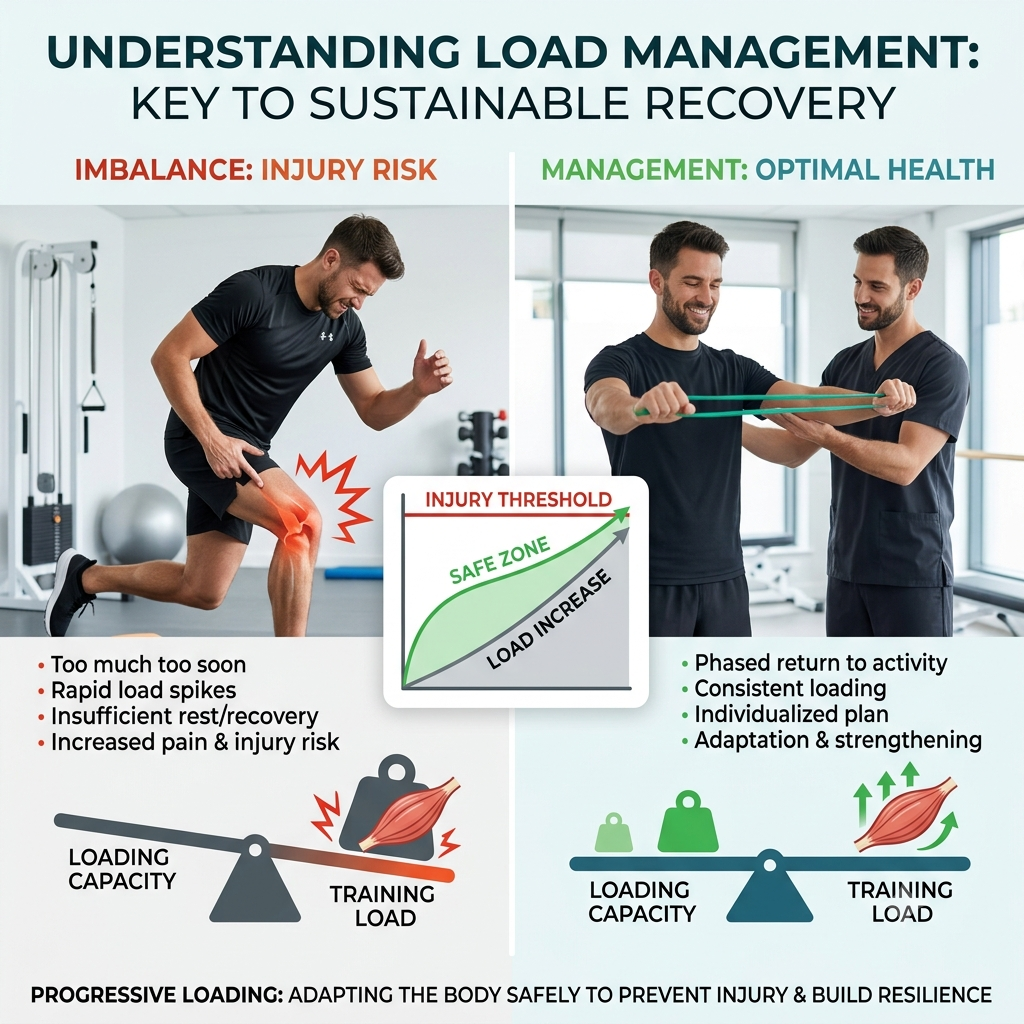
Load management refers to carefully controlling how much stress is placed on your body during recovery.
“Load” includes much more than exercise.
It includes:
- Walking
- Running
- Gym training
- Sport
- Lifting at work
- Sitting
- Gardening
- Household chores
- Parenting
- Sleep and recovery
- Psychological stress
- Training frequency
- Exercise intensity
Every tissue in your body has a capacity.
Recovery occurs when you apply the right amount of stress—not too much and not too little.
The Goldilocks Principle of Rehabilitation
Think of rehabilitation like watering a plant.
Too little water?
The plant dies.
Too much water?
The plant also dies.
Your body works the same way.
Too little load results in:
- Weakness
- Deconditioning
- Reduced tissue tolerance
- Ongoing stiffness
- Fear of movement
Too much load results in:
- Pain flare-ups
- Tendon irritation
- Joint inflammation
- Muscle overload
- Delayed healing
The goal is finding the “just right” amount of stress.
That is load management.
Why So Many Physiotherapy Programs Get Load Management Wrong
Unfortunately, load management is often one of the weakest parts of rehabilitation.
Mistake #1: Everyone Gets the Same Exercises
Many clinics hand out:
- Generic exercise sheets
- Standard strengthening programs
- Cookie-cutter rehabilitation
The problem?
Two people with the same MRI can have completely different load capacities.
One may tolerate:
- Squats
- Running
- Heavy lifting
The other may struggle to:
- Walk 15 minutes
- Sit comfortably
- Climb stairs
The exercise isn’t wrong.
The dosage is.
Mistake #2: Progressing Too Quickly
Many clients are told:
“If it doesn’t hurt, add more.”
Or:
“Increase the weight every week.”
Recovery doesn’t work like that.
Tissues adapt at different speeds.
Progression should depend on:
- Symptoms
- Recovery between sessions
- Sleep
- Fatigue
- Workload
- Training history
- Overall stress
Not simply time.
Mistake #3: Being Too Conservative
The opposite problem is equally common.
Many people are told to:
- Rest completely
- Stop exercising
- Avoid pain
- Wait until symptoms disappear
Unfortunately…
Bodies don’t become stronger through rest alone.
They become stronger through appropriate loading.
Complete rest often creates:
- Weakness
- Reduced confidence
- Loss of conditioning
- Longer recovery
Why Load Management Is More Important Than Almost Every Treatment
Manual therapy might reduce pain for a few hours.
Dry needling may reduce muscle tension.
Massage may help you feel looser.
But none of these treatments determine what happens over the next six months.
Load management does.
It determines:
- Whether symptoms settle
- Whether tissues become stronger
- Whether you return to work safely
- Whether you return to sport confidently
- Whether pain comes back
It’s one of the highest-value interventions physiotherapy has to offer.
How Narrow Gate Physiotherapy Gets Load Management Right
At Narrow Gate Physiotherapy, load management isn’t something we think about occasionally.
It’s woven into every stage of rehabilitation.
We Measure Capacity Before We Increase Capacity
Rather than guessing what your body can tolerate, we assess:
- Strength
- Endurance
- Mobility
- Functional movement
- Occupational demands
- Sporting requirements
- Previous injury history
- Recovery patterns
This gives us a realistic picture of what your body is ready for.
We Individualise Your Dosage
Exercise isn’t simply prescribed.
It’s dosed.
Just like medication.
We consider:
- Number of repetitions
- Number of sets
- Resistance
- Speed
- Range of motion
- Weekly frequency
- Recovery time
- Overall weekly workload
Small adjustments often make enormous differences.
We Consider Your Entire Life
Your body doesn’t separate work stress from gym stress.
Neither do we.
We ask about:
- Your occupation
- Sleep quality
- Family responsibilities
- Sporting commitments
- Gym routine
- Travel
- Fatigue
- Stress levels
Why?
Because all of these affect your recovery capacity.
We Teach You to Self-Manage
One of our biggest goals is helping clients understand their own body.
Rather than saying:
“Come back when it hurts again.”
We teach you:
- How to recognise overload early
- How to modify activity
- When to push
- When to back off
- How to progress independently
That’s how long-term success is built.
Why High Performers Love This Approach
Business owners.
Executives.
Professionals.
Athletes.
These clients understand something important:
Success comes from managing capacity—not constantly operating at maximum effort.
They appreciate:
- Data
- Planning
- Strategy
- Consistency
- Progressive improvement
Load management mirrors exactly how successful people already think.
The Long-Term Benefits of Good Load Management
When your rehabilitation is properly managed, you experience:
- Faster recovery
- Fewer flare-ups
- Greater confidence
- Stronger tissues
- Better movement quality
- Reduced reinjury risk
- Fewer physiotherapy sessions
- Less reliance on passive treatment
- Better long-term performance
Most importantly…
You develop a body that can tolerate life’s demands instead of constantly reacting to them.
Key Takeaways
- Load management is one of the most important treatments in physiotherapy.
- Recovery depends on applying the right amount of stress—not too much and not too little.
- Generic exercise programs often fail because they don’t individualise load.
- Rest alone rarely solves musculoskeletal problems.
- At Narrow Gate Physiotherapy, load management is personalised, evidence-based, and integrated into every rehabilitation program.
Conclusion
The best physiotherapy isn’t about providing more treatment.
It’s about applying the right treatment at the right time and in the right amount.
That’s exactly what load management achieves.
At Narrow Gate Physiotherapy, we don’t simply prescribe exercises and hope for the best. We carefully measure your current capacity, design a rehabilitation plan that fits your lifestyle, and progressively increase your load as your body adapts.
The result is more than just pain relief. It’s lasting resilience, greater confidence, and a reduced risk of future injury.
If you’ve experienced repeated flare-ups, recurring injuries, or physiotherapy that never seemed to create lasting change, it may not be because physiotherapy doesn’t work.
It may simply be that your load was never managed properly.
You can make a booking online or call us on 0478 260 200. For a limited time, we have free discovery sessions where you get assessed by our physiotherapists and given an outline of how we can help you to have full confidence in working with us. We also offer promotions that include discounted initial sessions to incentivise getting started with your rehabilitation journey.