Introduction
One of the most common concerns we hear from new clients is:
“Why am I more sore after my first physiotherapy session?”
Or,
“The exercises seem to have stirred things up. Is that normal?”
The answer is:
Sometimes, yes.
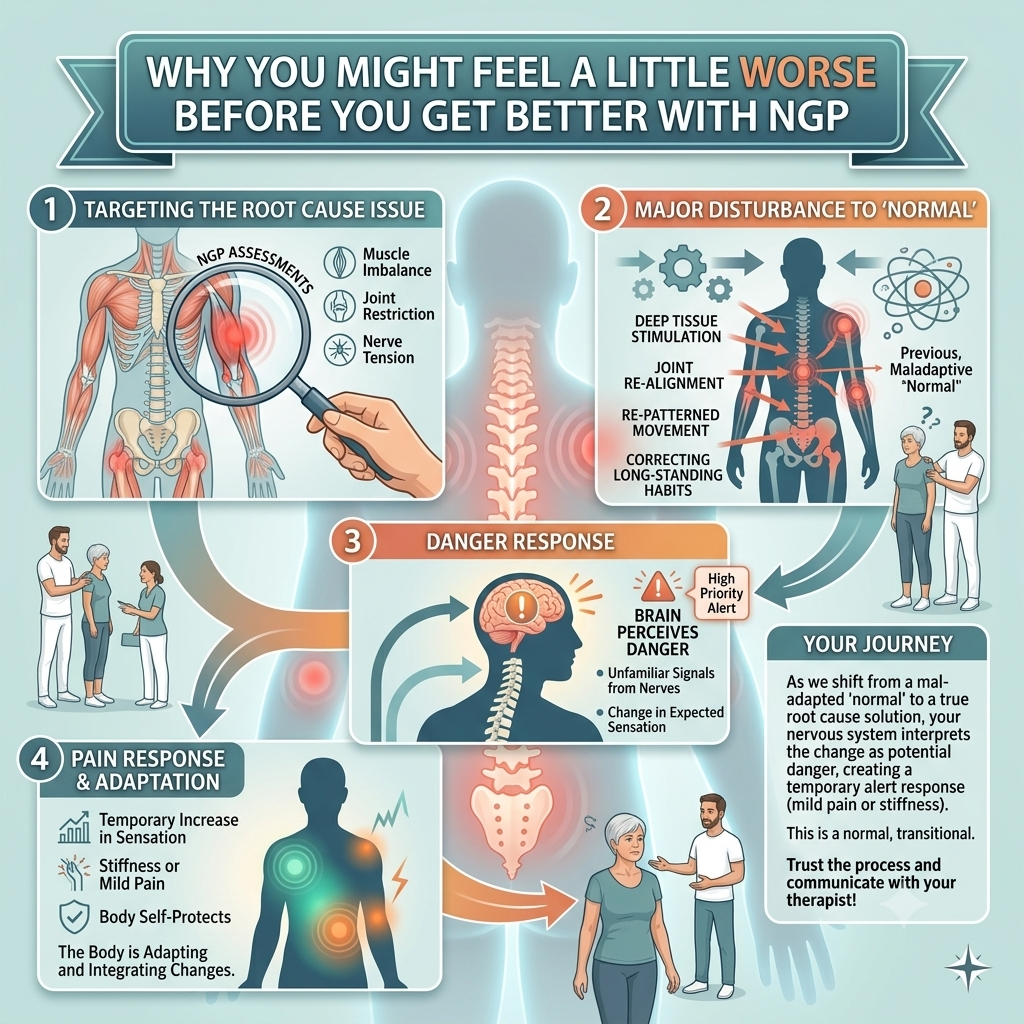
At Narrow Gate Physiotherapy (NGP), our goal isn’t simply to make you feel better for a few hours. Our goal is to identify and address the root cause of your problem.
Sometimes, correcting the real problem temporarily challenges your body’s “normal” way of functioning. This can briefly increase discomfort before meaningful improvement begins.
Understanding why this happens can help you approach rehabilitation with confidence rather than concern.
Your Body Loves Familiarity
The human nervous system prefers what is familiar.
Even if your movement pattern isn’t ideal, your brain often sees it as “normal” because it has become accustomed to it over weeks, months, or even years.
For example, you may have:
- Walked with a limp for months
- Sat with poor posture for years
- Avoided using one shoulder after an injury
- Relied heavily on one leg because of knee pain
These movement patterns become your body’s default strategy.
They may not be healthy, but they feel familiar.
Recovery Often Requires Changing What’s Normal
One of our primary goals is to improve the way your body moves.
That may involve:
- Activating muscles that have become weak
- Reducing overuse of muscles that have been compensating
- Changing posture
- Correcting movement patterns
- Gradually increasing load through injured tissues
Although these changes are beneficial, they are also different.
And your nervous system notices.
Your Brain Is Designed to Protect You
Pain is not always a sign of damage.
Pain is often a protective response.
Your brain continuously asks questions like:
- Is this movement safe?
- Is this different?
- Have I done this before?
- Should I protect this area?
When rehabilitation introduces new movement patterns or loads, your nervous system may initially become more cautious.
This can result in:
- Mild soreness
- Temporary stiffness
- Fatigue
- Increased awareness of the injured area
This doesn’t necessarily mean the exercises are harmful.
Sometimes it simply means your body is adapting to something new.
Think of It Like Learning a New Skill
Imagine you’ve driven the same route to work every day for ten years.
One day, a road closure forces you to take a completely different route.
At first, it feels unfamiliar.
You may make wrong turns or drive more cautiously.
Eventually, the new route becomes comfortable.
Your body works in a similar way.
We’re often asking it to abandon an old strategy and learn a better one.
That process takes time.
The Difference Between Adaptation and Aggravation
Some discomfort during rehabilitation can be expected.
Examples include:
- Mild muscle soreness
- Temporary stiffness
- Fatigue after exercise
- Symptoms that settle within 24–48 hours
These are often signs that your body is adapting.
However, rehabilitation should not cause:
- Severe or worsening pain
- Significant swelling
- Progressive loss of function
- Symptoms that continue worsening day after day
At Narrow Gate Physiotherapy, we monitor your response carefully and adjust your program if your body is not tolerating the current level of loading.
We Intentionally Challenge the Root Cause
Many treatments focus on making symptoms disappear temporarily.
At NGP, we ask a different question:
“Why is this problem happening in the first place?”
Sometimes that means strengthening muscles that haven’t been used properly for years.
Sometimes it means teaching your spine, shoulder, knee, or foot to move differently.
Sometimes it means increasing your activity after months of avoiding movement.
These changes are often exactly what your body needs—but they can initially feel unfamiliar.
Why Passive Treatment Sometimes Feels Easier
Passive treatments like massage or heat can often provide short-term relief because they don’t ask your body to change.
Exercise-based rehabilitation is different.
It asks your body to:
- Learn new movement patterns
- Build strength
- Increase capacity
- Become more resilient
That process creates adaptation.
And adaptation sometimes involves temporary discomfort.
The goal isn’t just to feel better today.
The goal is to function better for years to come.
We Progress Rehabilitation Carefully
At Narrow Gate Physiotherapy, we don’t believe in pushing people through unnecessary pain.
Instead, we aim to find the right balance.
Every exercise program is progressed based on:
- Your symptoms
- Your goals
- Your recovery stage
- Your ability to tolerate load
- Your response between appointments
Some challenge is expected.
Too much challenge delays recovery.
Too little challenge prevents progress.
Finding the right balance is where clinical experience matters.
Communication Is Essential
One of the most important parts of rehabilitation is letting your physiotherapist know how you’re responding.
Tell us if:
- Exercises feel too easy
- Pain lasts longer than expected
- You notice new symptoms
- Certain activities become easier
- Your confidence is improving
Your feedback helps us fine-tune your rehabilitation program.
Physiotherapy is a partnership.
Why High Performers Often Recover Well
Many of our clients are executives, professionals, athletes, and business owners.
One characteristic they often share is an understanding that meaningful improvement sometimes requires short-term discomfort.
Just as muscles become stronger after training, the body often needs to be challenged appropriately to improve.
The key is ensuring that challenge is controlled, purposeful, and progressive.
How Narrow Gate Physiotherapy Minimises Flare-Ups
Although some temporary soreness can occur, our assessment process is designed to minimise unnecessary aggravation.
Every client receives:
- A comprehensive assessment before treatment
- An individualised exercise program
- Careful load progression
- Regular reassessment
- Ongoing education about what is normal during recovery
Our aim is to challenge your body enough to stimulate improvement—without overwhelming it.
Key Takeaways
- Feeling slightly worse after starting physiotherapy is sometimes a normal part of recovery.
- The body often resists changes to long-standing movement patterns.
- Mild soreness and stiffness can be signs of adaptation, not damage.
- Addressing the root cause may temporarily feel unfamiliar before it feels better.
- Rehabilitation should be progressively challenging—not excessively painful.
- Open communication with your physiotherapist helps ensure your program stays on track.
Conclusion
At Narrow Gate Physiotherapy, we don’t chase quick fixes—we build lasting solutions.
Sometimes, that means asking your body to move differently than it has for months or even years.
That change can briefly trigger a protective response because your nervous system is adjusting to a new, healthier way of moving.
Our role is to guide you through that transition safely and confidently.
We don’t want you to simply return to your old “normal.”
We want to help you build a new normal—one that is stronger, more resilient, and less likely to lead to pain in the future.
You can make a booking online or call us on 0478 260 200. For a limited time, we have free discovery sessions where you get assessed by our physiotherapists and given an outline of how we can help you to have full confidence in working with us. We also offer promotions that include discounted initial sessions to incentivise getting started with your rehabilitation journey.