
Physiotherapy should help you move towards meaningful improvements in pain, movement, strength and everyday function. But what happens when you have been attending appointments, following your exercises and still feel like you are not getting anywhere?
Perhaps your back pain keeps returning. Your knee feels better after treatment but hurts again when you exercise. Or you have been doing the same rehabilitation programme for weeks without noticing much difference.
It is natural to wonder whether you need more time, a different approach or a fresh assessment.
The truth is that recovery is not always a straight line. Some injuries improve gradually, and temporary setbacks can happen. However, if your progress has stalled, your symptoms are worsening or your treatment no longer matches your goals, it may be time to review your physiotherapy plan.
At Narrow Gate Physiotherapy in Belmore, NSW, we believe treatment should have a clear purpose, measurable goals and a willingness to adapt when the evidence suggests a change is needed.
Here are five signs your physiotherapy treatment plan may need to change.
1. You Are Not Making Meaningful Progress
One of the clearest signs that a treatment plan needs reviewing is a lack of meaningful progress over time.
You do not necessarily need to be pain-free after a few sessions. Some conditions, particularly persistent tendon problems, significant injuries and long-standing musculoskeletal pain, may take weeks or months to improve.
However, your rehabilitation should have a clear direction.
Depending on your condition, progress might include:
- Reduced pain intensity or fewer flare-ups.
- Improved joint movement or flexibility.
- Greater strength or endurance.
- Better tolerance for walking, lifting, sitting or exercise.
- Improved confidence when performing previously difficult movements.
- A gradual return to work, sport or daily activities.
For example, imagine you are receiving physiotherapy for shoulder pain. After several weeks, you are still unable to lift your arm comfortably, your strength has not improved and everyday activities remain just as difficult.
Rather than continuing with exactly the same programme indefinitely, your physiotherapist should review your response and consider whether the assessment, exercise selection, training load or treatment approach needs adjusting.
What should you do?
Start by discussing your progress with your physiotherapist.
Ask what improvements you should reasonably expect at this stage, which outcomes are being measured and what the next step should be if progress remains limited.
A review may confirm that the current plan is appropriate and needs more time. Alternatively, it may identify a reason to modify the programme or seek further medical assessment.
The important thing is that you understand why you are continuing with the current approach.
2. Your Pain Keeps Returning After Treatment
Does your pain improve immediately after physiotherapy, only to return a day or two later?
This can be frustrating, especially when you feel as though you are repeatedly starting from the beginning.
However, recurring pain does not automatically mean your treatment has failed. Some conditions naturally fluctuate, and temporary symptom relief can still be useful.
The question is whether your overall function is improving between appointments.
Consider someone with lower back pain who feels better after a treatment session but experiences the same symptoms whenever they return to lifting at work.
Several factors could be involved:
- Their lifting demands may exceed their current physical capacity.
- They may need to progressively rebuild strength and endurance.
- Their workload or recovery time may need adjusting.
- The current treatment may be helping symptoms without sufficiently addressing the demands they need to tolerate.
- The original diagnosis or explanation may need to be reviewed.
These are possibilities, not assumptions. The cause of recurring pain needs to be considered in the context of your individual presentation.
What should you do?
Your treatment plan may need to place greater emphasis on the activities that trigger your symptoms, rather than focusing exclusively on temporary relief.
Depending on your condition, this could involve progressive strengthening, activity modification, load management, education or a reassessment of the original problem.
At Narrow Gate Physiotherapy, we aim to help clients understand how to manage their symptoms while building the capacity needed for everyday life.
The goal is not simply to feel better on the treatment table. It is to make meaningful progress outside the clinic, too.
3. Your Exercises Are Too Easy, Too Difficult or No Longer Relevant
Exercise is an important part of many physiotherapy programmes, but the right exercise at the beginning of rehabilitation may not be the right exercise several weeks later.
Your body adapts as your strength, coordination and tolerance improve. A programme that was once challenging may eventually become too easy to produce further progress.
The opposite can also happen. Exercises may be too demanding for your current capacity, aggravate your symptoms excessively or make it difficult to recover between sessions.
Your goals can also change as your rehabilitation progresses.
For example, a person recovering from a knee injury may initially focus on comfortable walking and basic strengthening. Later, if their goal is to return to basketball, they may need a more advanced programme involving jumping, landing, acceleration and changes of direction, when appropriate for their injury.
Continuing with only the initial exercises may not prepare them for these higher demands.
Signs your exercise programme may need adjusting
- You can complete every exercise easily but are no longer progressing.
- Your symptoms consistently worsen after exercises and do not settle as expected.
- You are unable to complete the prescribed exercises because they are too difficult.
- You have regained everyday function but are not progressing towards your sporting or work goals.
- Your programme does not reflect your current abilities or priorities.
What should you do?
Do not automatically increase the weights, repetitions or intensity yourself, particularly if you have a significant injury or specific medical restrictions.
Discuss your response with your physiotherapist.
They may adjust the exercise selection, range of movement, resistance, repetitions, frequency or recovery periods. They may also introduce more task-specific exercises as you become ready for them.
Good rehabilitation should evolve with your capacity. It should challenge you appropriately without progressing faster than your condition allows.
4. Your Treatment Plan Does Not Match Your Actual Goals
A treatment plan can include appropriate exercises and techniques yet still fall short if it does not address what you actually need to do.
Your goals should influence the direction of your rehabilitation.
For example:
- An office worker may want to complete a full working day without frequent back pain.
- A tradesperson may need to tolerate repeated lifting, carrying and bending.
- A runner may want to return to their previous training distance.
- A basketball player may need to regain confidence with jumping, landing and changing direction.
- An older adult may want to walk independently and feel more confident moving around the home.
These goals require different approaches.
Improving general strength may be useful, but it may not be enough if your rehabilitation never progresses towards the specific activities you need to perform.
Likewise, someone whose main priority is returning to comfortable daily movement may not need an intensive sports-performance programme.
What should you do?
Make sure your physiotherapist understands what success looks like for you.
Ask yourself:
- What activity am I currently unable to do?
- What would meaningful improvement look like?
- Has my rehabilitation progressed towards that outcome?
- Are the exercises relevant to the demands I need to manage?
At Narrow Gate Physiotherapy, we believe rehabilitation should be personalised to your circumstances rather than following a standard programme for everyone with the same diagnosis.
Your goals provide a practical way to determine whether the plan is working.
5. Your Symptoms Are Getting Worse or the Diagnosis Needs Reviewing
Sometimes, the most important sign that a treatment plan needs to change is that your condition is not behaving as expected.
A temporary increase in symptoms can occur during rehabilitation, particularly when activity levels change. However, persistent deterioration, new symptoms or a significant loss of function should not simply be ignored.
For example, if you are receiving treatment for knee pain but develop substantial swelling, increasing instability or an inability to straighten the knee, you may need further assessment rather than simply continuing the same exercises.
Similarly, new neurological symptoms alongside back or neck pain may require medical review.
Your physiotherapist should consider whether the current plan remains appropriate and whether referral for medical assessment or further investigation is needed.
When should you seek urgent medical attention?
Seek urgent medical assessment for concerning symptoms such as:
- Severe pain or major swelling following significant trauma.
- A suspected fracture or dislocation.
- New or rapidly worsening limb weakness.
- New loss of bladder or bowel control, or numbness around the groin or saddle area with back pain.
- A hot, red, swollen joint accompanied by fever.
- Chest pain or difficulty breathing.
These symptoms may indicate a problem that needs urgent medical care. Do not wait for your next routine physiotherapy appointment.
What should you do if progress has stalled?
A reassessment may help clarify whether the problem involves your current rehabilitation programme, activity demands, the original diagnosis or another health issue.
Sometimes the plan needs a small adjustment. In other cases, further medical investigation or input from another health professional may be appropriate.
Changing direction is not an admission of failure. It is part of making informed clinical decisions.
Why Does Physiotherapy Need Regular Reassessment?
Physiotherapy should not be a fixed programme that continues unchanged regardless of your response.
Your symptoms, strength, mobility, activity levels and goals can change throughout recovery. Regular reassessment helps determine whether your treatment remains appropriate.
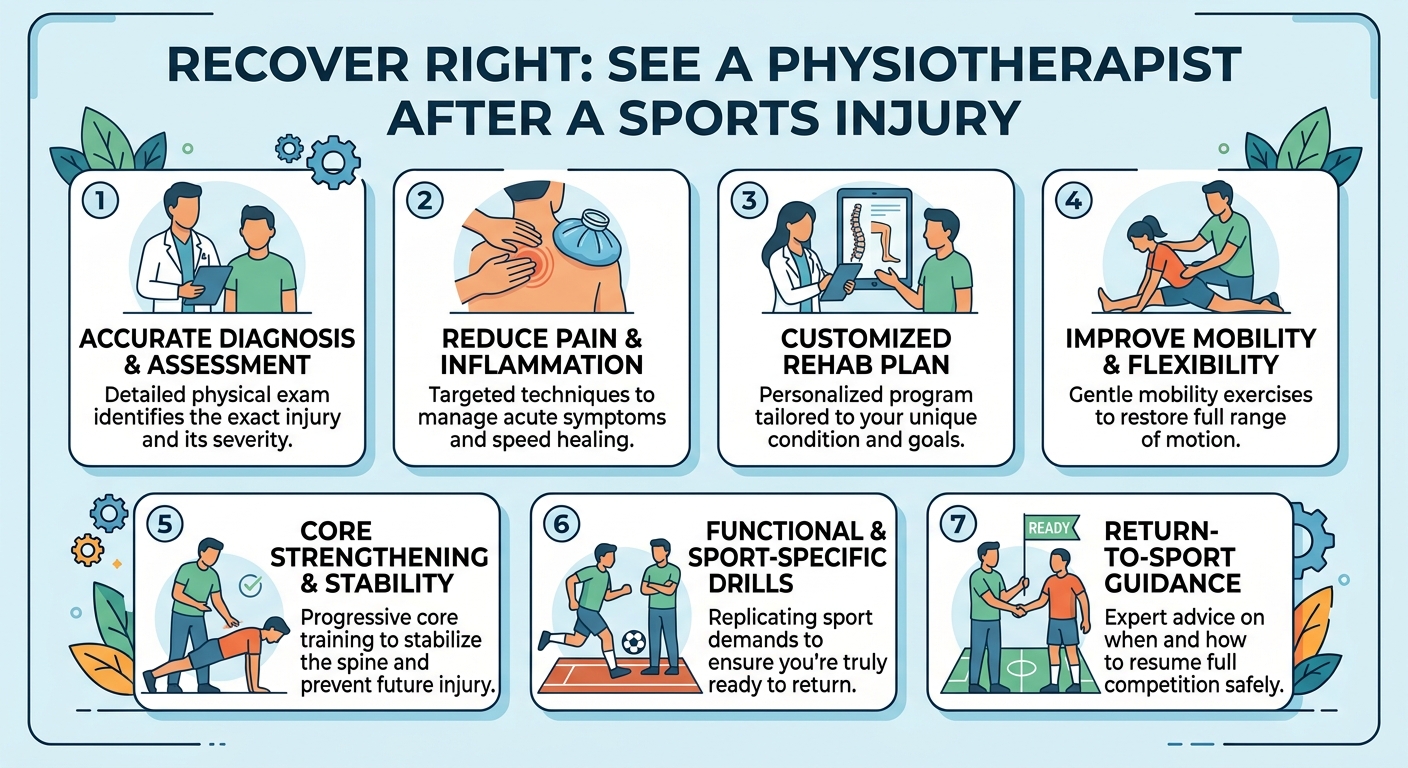
At Narrow Gate Physiotherapy, our approach includes five key stages.
1. Subjective History (SHx)
We review your symptoms, injury history, daily activities, work demands and goals. If something has changed since your last appointment, that information can influence the next step.
2. Objective Assessment (OHx)
We assess relevant aspects of movement, strength, mobility and function to understand your current capacity and identify areas that may need attention.
3. Rehabilitation and Prescription (Rx)
We develop or adjust your exercise programme and other appropriate interventions based on your needs.
4. Re-Assessment (Re-Ax)
We review whether the plan is producing meaningful improvements and whether the next stage of rehabilitation should be progressed, modified or reconsidered.
5. Follow-Up (F/U)
We support you as you work towards your goals, building greater independence as your ability to manage the programme improves.
This process helps keep treatment purposeful. It also creates opportunities to recognise when the current approach is not delivering the expected results.
Does Changing Your Physiotherapy Plan Mean Your Previous Treatment Failed?
Not necessarily.
Rehabilitation involves learning how your body responds to different forms of treatment and activity. Sometimes the initial plan works well. Sometimes it needs adjustment as more information becomes available.
For example, an exercise may be appropriate at the beginning of recovery but become less relevant as your strength improves. Alternatively, an activity may provoke more symptoms than expected, indicating that its intensity or timing needs to change.
A good treatment plan allows for these decisions.
The aim is not to find one perfect treatment that works forever. It is to make informed adjustments that support your recovery and goals.
It is also reasonable to ask your physiotherapist to explain the purpose of each treatment, how progress will be measured and when the plan will be reviewed.
If your concerns are not being addressed, you can seek another professional opinion.
The Narrow Gate Physiotherapy Approach: Get You Better, Keep You Better, Help You Stay Better
At Narrow Gate Physiotherapy in Belmore, NSW, we believe effective physiotherapy requires more than repeating treatments because they were prescribed at the beginning.
Our approach focuses on three priorities.
Get you better: Understand your symptoms, establish an appropriate starting point and help you improve pain and function.
Keep you better: Progress your rehabilitation to build the strength, movement and physical capacity relevant to your goals.
Help you stay better: Develop your understanding of your condition and your ability to manage physical demands, respond to flare-ups and recognise when further support may be needed.
We want you to understand why you are doing each exercise, what improvement we are working towards and how your progress will be assessed.
For some people, a small adjustment to their current plan is all that is needed. Others may benefit from a more comprehensive reassessment.
Our goal is to provide care that is individualised, purposeful and directed towards meaningful outcomes, rather than keeping you in treatment indefinitely without a clear reason.
Frequently Asked Questions
How long should I wait before changing my physiotherapy plan?
There is no universal timeframe. It depends on your condition, its expected recovery pattern and your response to treatment. If symptoms are worsening, new symptoms develop or you have concerns about your progress, raise them promptly rather than waiting for an arbitrary number of weeks.
Is it normal to feel more pain after physiotherapy?
Some people experience temporary symptom increases after exercise or treatment. However, significant, persistent or progressively worsening pain should be reviewed. Your response depends on the condition and the type of activity performed.
Should I change physiotherapists if I am not improving?
Not necessarily. Start by discussing your concerns and asking for a review of your progress, goals and treatment plan. If your concerns are not addressed or you would like another opinion, seeking a different physiotherapist may be reasonable.
Can I stop physiotherapy once the pain improves?
Sometimes. The decision depends on whether you have regained the function and capacity required for your activities. Some injuries need further rehabilitation even after pain decreases, while other conditions may be managed independently once symptoms and function improve sufficiently.
How do I know whether my physiotherapist’s treatment is working?
Look at your overall progress, not just how you feel immediately after an appointment. Relevant signs include better movement, improved strength, fewer or more manageable symptoms, greater activity tolerance and progress towards your personal goals.
Final Thoughts
Physiotherapy is not meant to be a process of repeating the same exercises and treatments indefinitely.
Your treatment plan should respond to your progress, your symptoms and the activities you want to return to.
If you are not improving, your pain keeps returning, your exercises no longer challenge you appropriately, your goals are not being addressed or your symptoms are worsening, it may be time to review the plan.
Sometimes, the answer is more time. Sometimes, it is a change in exercise, workload or treatment strategy. And sometimes, it is further medical assessment.
The important thing is to understand why your current plan is being continued and what needs to happen next.
At Narrow Gate Physiotherapy, we aim to help you get better, keep you better and help you stay better through personalised assessment, purposeful rehabilitation and practical self-management.
If your current treatment is not delivering the progress you expected, contact Narrow Gate Physiotherapy in Belmore, NSW, on 0478 260 200 to discuss whether a reassessment may help.