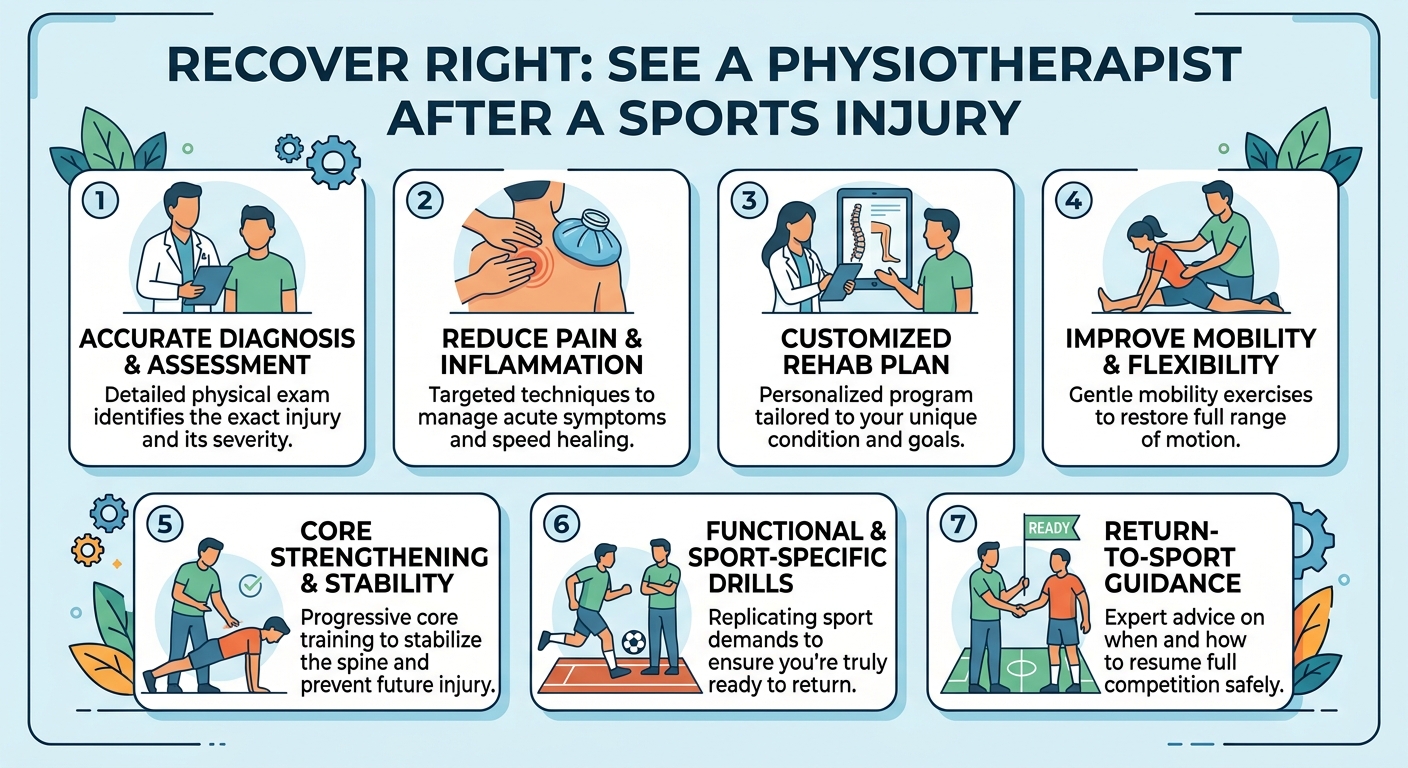
You twist your ankle during a basketball game. You feel a sharp pull in your hamstring while sprinting. Or perhaps your shoulder starts hurting after a heavy gym session.
Your first thought might be to rest, apply ice and see how you feel tomorrow.
Sometimes, that is enough for a minor injury to settle. But other injuries need early assessment, and continuing to train or compete without understanding the problem can delay recovery or increase the risk of further injury.
So, when should you see a physiotherapist after a sports injury?
The answer depends on the severity of your symptoms, how the injury happened and whether you can move and use the affected area normally.
At Narrow Gate Physiotherapy in Belmore, NSW, we help active people understand their injuries, make informed decisions about returning to sport and progressively rebuild the strength and capacity needed to perform confidently.
1. See a Physiotherapist Early If Pain Affects Your Movement
You do not necessarily need to wait until an injury becomes severe before seeking help.
Consider booking a physiotherapy assessment if you notice any of the following:
- Pain that makes you limp or changes the way you run.
- Swelling that affects movement or weight-bearing.
- Difficulty moving a joint through its usual range.
- Weakness that prevents you from performing normal sporting movements.
- Pain that repeatedly returns during training.
- Reduced performance that does not improve with appropriate modification of activity.
- Symptoms that are not improving as expected.
- An injury that makes you hesitant or uncomfortable when changing direction, jumping, lifting or accelerating.
These symptoms do not automatically indicate a serious injury. However, they may suggest that your body is not tolerating your current sporting demands.
A physiotherapist can assess your symptoms, identify relevant movement and strength limitations, and determine whether rehabilitation or further medical assessment is appropriate.
The goal is to understand the injury before deciding how much training you can safely continue.
2. When Should You Seek Urgent Medical Attention Instead?
Not every sports injury should go straight to a routine physiotherapy appointment.
Some injuries require urgent medical assessment, particularly when there may be a fracture, dislocation, significant tissue damage or another serious condition.
Seek urgent medical care if you experience:
- A visible deformity or a suspected fracture.
- Severe pain or swelling following significant trauma.
- Inability to bear weight after an injury, particularly when accompanied by substantial pain or swelling.
- A joint that appears dislocated.
- A sudden pop accompanied by major weakness or loss of function.
- A wound with significant bleeding or an injury involving an exposed bone.
Seek emergency care if you experience a head injury with loss of consciousness, worsening confusion, repeated vomiting, a seizure or other concerning neurological symptoms.
Stop playing immediately and seek urgent assessment if you suspect a serious injury. Do not attempt to force a joint back into place or continue competing to see whether it improves.
For a suspected concussion, remove yourself from play and obtain appropriate medical assessment. Do not return to sport on the same day if concussion is suspected.
A physiotherapist can help manage many sports injuries, but the first priority is recognising when medical care must come before rehabilitation.
3. Common Sports Injuries That Benefit From Physiotherapy
Different injuries require different approaches. Here are some common sporting problems where a physiotherapy assessment may be useful.
Ankle sprains
An ankle sprain often occurs when the foot rolls unexpectedly during landing, running or changing direction.
You may experience pain, swelling, bruising or difficulty walking.
Physiotherapy may help restore ankle movement, strength, balance and confidence. These factors are particularly important for sports involving jumping, rapid direction changes and uneven surfaces.
However, significant pain or difficulty bearing weight after an ankle injury may require medical assessment to rule out a fracture or other serious injury.
Hamstring strains
Hamstring strains commonly occur during sprinting, acceleration or explosive movements.
Symptoms may include sudden pain at the back of the thigh, tenderness, weakness and difficulty running.
Rehabilitation often involves gradually rebuilding strength and the ability to tolerate faster running. Returning to full-speed sprinting too early may increase the risk of another injury.
Knee injuries
Knee injuries can occur during twisting movements, awkward landings, direct contact or sudden changes in direction.
Depending on the injury, symptoms may include swelling, pain, instability or difficulty straightening the knee.
A knee that locks, gives way significantly or develops rapid swelling after trauma needs prompt assessment. Physiotherapy may form part of rehabilitation, but some injuries require imaging, specialist review or surgery.
Shoulder injuries
Shoulder pain can develop during throwing, swimming, weightlifting, contact sport or overhead activities.
The problem may involve muscles, tendons, joints or other structures around the shoulder.
A physiotherapist can assess relevant movement, strength and functional limitations and develop a plan based on the suspected injury and your sporting goals.
A suspected dislocation or significant traumatic injury should be assessed urgently.
Achilles tendon pain
Achilles tendon pain may develop when running volume, jumping or training intensity increases beyond what the tendon currently tolerates.
Symptoms can include pain or stiffness around the tendon, particularly during activity or after periods of rest.
Physiotherapy may involve load management and progressive calf strengthening. However, a sudden pop in the back of the ankle or calf, especially with difficulty pushing off or standing on tiptoe, may indicate an Achilles tendon rupture and requires urgent medical assessment.
Muscle strains and groin injuries
Muscle strains can affect the calf, quadriceps, groin and other muscle groups.
The appropriate recovery plan depends on the muscle involved, injury severity and sporting demands. Rehabilitation may involve progressively restoring strength, speed, coordination and sport-specific movement.
Trying to return to explosive activity simply because everyday walking feels comfortable may not be enough to establish readiness.
4. Should You Wait a Few Days to See Whether the Injury Improves?
For a minor injury with mild symptoms, normal movement and no concerning signs, temporarily reducing the aggravating activity and monitoring your symptoms may be reasonable.
However, waiting is not always the best option.
Consider an assessment earlier if:
- You cannot walk or move normally.
- Swelling or bruising is substantial.
- You suspect a significant muscle, ligament or tendon injury.
- Your symptoms worsen rather than improve.
- You have an important competition or physically demanding event approaching.
- You have experienced the same injury several times.
Early assessment does not necessarily mean you will need extensive treatment. It can help clarify what activities are appropriate, whether further investigation is needed and how to begin recovery.
If symptoms are mild but persist or repeatedly return, a physiotherapist can help determine whether your training load, strength, recovery or another factor needs attention.
The important point is not to treat every minor ache as an emergency. It is to recognise when an injury needs more than guesswork.
5. Should You Keep Training With a Sports Injury?
This depends on the injury.
Some conditions allow modified training while you recover. Others require you to stop particular activities until the injury has been assessed or has reached an appropriate stage of healing.
Continuing to train through pain without understanding the cause can make it harder to judge whether the injury is improving.
For example, a runner with mild tendon-related pain may be able to continue some activity with an adjusted training programme. A person with a suspected ligament rupture or fracture needs a different approach.
Your physiotherapist may help you decide whether to:
- Temporarily stop the activity that aggravates your symptoms.
- Reduce training intensity, duration or frequency.
- Substitute a lower-impact activity where appropriate.
- Continue selected strength or conditioning exercises.
- Progress towards running, jumping or sport-specific drills in stages.
The aim is to maintain as much appropriate activity as possible without compromising recovery.
Do not use pain alone as proof that an injury is safe to train on. Some injuries can cause relatively little pain despite significant damage, while other conditions remain painful without indicating further tissue damage.
The decision should consider the injury, your function and your response to activity.
6. How Long Should You Wait Before Returning to Sport?
There is no single timeline that applies to every sports injury.
A minor strain may settle within a few weeks, while a significant ligament injury, tendon problem or injury requiring surgery may need months of rehabilitation.
More importantly, returning to sport should depend on your readiness, not simply the number of days since the injury.
Your physiotherapist may consider the following factors.
Pain and swelling
Symptoms should be manageable and consistent with the stage of recovery. Significant or increasing swelling may indicate that the current level of activity needs to be reviewed.
Range of motion
You should regain the movement needed for your sport, taking into account the injury and any specific medical restrictions.
Strength and endurance
The injured area needs sufficient strength and capacity for the demands of training and competition.
Balance and coordination
Sports involving landing, contact or changes of direction often require good control of movement under different conditions.
Sport-specific performance
Depending on the injury, your rehabilitation may progress through drills such as jogging, acceleration, jumping, landing, cutting, kicking or throwing.
Response to training
You also need to consider how the body responds during activity and afterwards. A training session that appears manageable at the time may still cause a substantial flare-up later.
Return-to-sport decisions should be individualised. Some injuries have specific clinical or surgical criteria that need to be met before particular activities are safe.
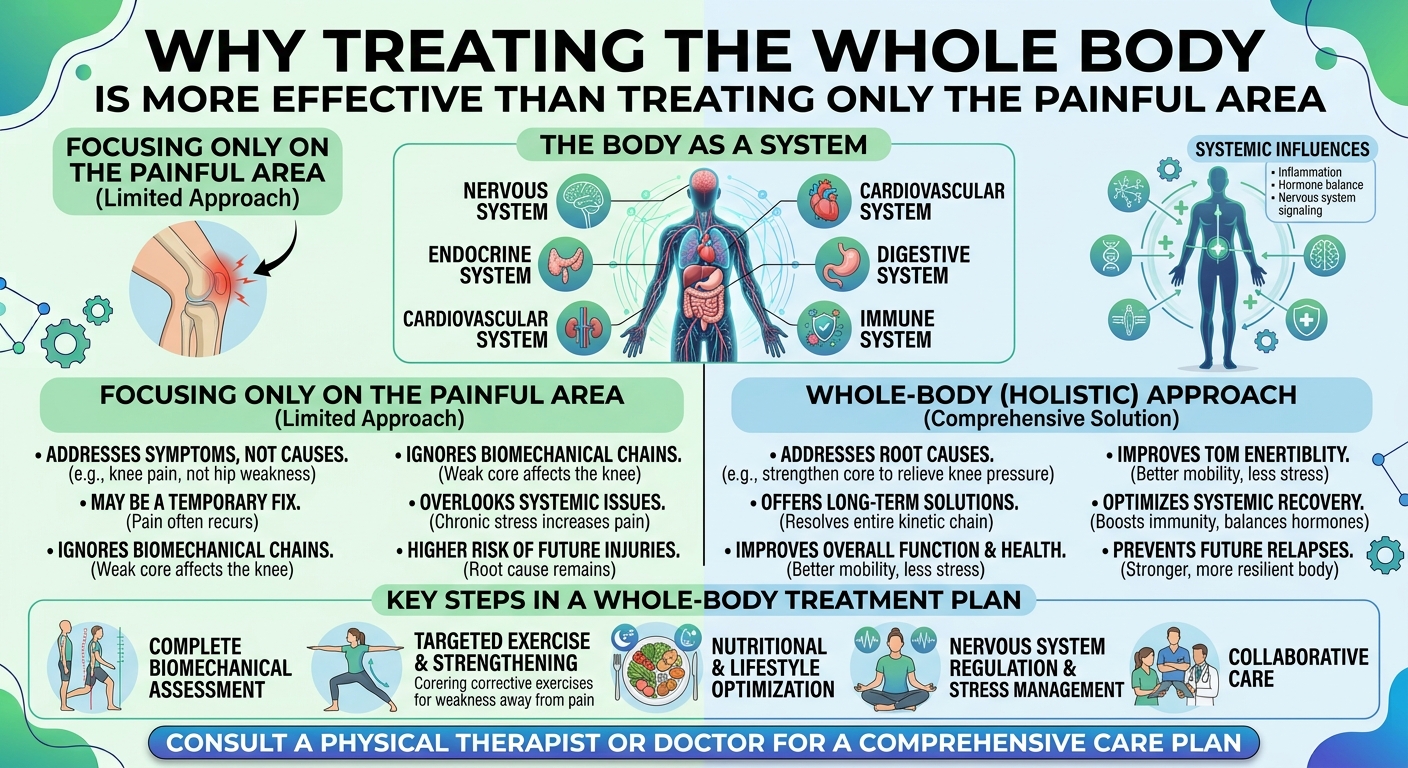
7. Why Treating Pain Alone May Not Be Enough
One of the biggest mistakes athletes make is assuming that less pain means they are ready to compete.
Imagine a basketball player who sprains an ankle.
After several days, the swelling decreases and walking becomes more comfortable. The player decides to return to training.
However, basketball requires repeated jumping, landing, acceleration and rapid changes of direction. The ankle may not yet have regained the strength, balance and movement control needed for these demands.
The player may feel fine during warm-up but struggle when training intensity increases.
This is why rehabilitation often needs to progress beyond symptom relief.
Depending on the injury, treatment may focus on:
- Restoring relevant strength and mobility.
- Improving balance and coordination.
- Rebuilding endurance and load tolerance.
- Practising sport-specific movements.
- Progressively increasing training intensity.
- Developing a plan to manage future increases in workload.
This does not mean every injury requires an extensive programme. The rehabilitation should be proportionate to the injury and the level of sport you want to return to.
8. How Load Management Helps Prevent Further Problems
Your body adapts to physical activity, but the demands need to be appropriate for your current capacity.
A sudden increase in training volume, intensity or frequency may contribute to an injury, particularly when recovery is insufficient.
For example:
- A runner suddenly doubles their weekly distance.
- A football player returns to full training after several weeks off.
- A gym member resumes heavy lifting after a long break.
- A basketball player adds extra games without allowing sufficient recovery.
In these situations, the issue may not be that exercise is inherently harmful. It may be that the body is not yet prepared for the amount of work being demanded.
A physiotherapist can help you review your training and develop a more gradual progression.
This may involve adjusting the number of sessions, modifying intensity, incorporating recovery days or rebuilding strength before returning to high-demand activity.
The goal is not to avoid hard training. It is to build the capacity to tolerate it.
9. What to Expect at Your First Sports Physiotherapy Appointment
At Narrow Gate Physiotherapy, we believe an effective sports injury assessment should help you understand what may be happening and what to do next.
Your appointment may involve five key stages.
1. Subjective History (SHx)
We discuss how the injury happened, your symptoms, previous injuries, training history and sporting goals.
2. Objective Assessment (OHx)
We assess relevant movement, strength, mobility, balance and function, provided it is appropriate and safe to do so.
3. Rehabilitation and Prescription (Rx)
We develop an individualised plan, which may include exercises, activity modifications, load management and advice about whether medical review is needed.
4. Re-Assessment (Re-Ax)
We review your progress and adjust the programme according to your response and changing physical capacity.
5. Follow-Up (F/U)
We help you progress towards your goals, including a suitable return to training and sport where appropriate.
Not every injury can be diagnosed definitively during one appointment. Some cases require medical review or further investigations. A good assessment should identify those situations rather than promise certainty where it is not possible.
10. The Narrow Gate Physiotherapy Approach: Get You Better, Keep You Better, Help You Stay Better
At Narrow Gate Physiotherapy in Belmore, NSW, we work with people who want to recover from injury and return to the activities that matter to them.
Our approach focuses on three priorities.
Get you better
We assess your injury, help you manage symptoms and identify the most appropriate next steps.
Keep you better
We progressively rebuild the strength, movement, endurance and sport-specific capacity needed for your goals.
Help you stay better
We help you understand your body, manage training loads and recognise when symptoms need attention.
Whether you play basketball, football, tennis, run, lift weights or participate in recreational sport, your rehabilitation should reflect your injury and the demands of your chosen activity.
The aim is not simply to get you back onto the field as quickly as possible. It is to help you return at an appropriate stage of recovery, with a plan that supports your longer-term physical health.
Frequently Asked Questions
Should I see a physiotherapist immediately after a sports injury?
Seek urgent medical assessment first if you suspect a fracture, dislocation, serious tendon injury or another significant injury. For less severe injuries, early physiotherapy may help clarify the problem and guide your recovery.
Can I see a physiotherapist the day after an injury?
Often, yes, if the injury is suitable for routine physiotherapy assessment and you do not have signs requiring urgent medical care. A physiotherapist can assess your symptoms and advise on appropriate activity and next steps.
Should I put ice on a sports injury?
A wrapped cold pack may provide short-term pain relief for some acute injuries. Avoid applying ice directly to the skin. Ice is not essential for every injury and does not replace an appropriate assessment or rehabilitation plan.
How do I know if my sports injury is serious?
Severe pain, substantial swelling, deformity, inability to bear weight, marked weakness or loss of function may indicate a more significant injury. Seek urgent assessment when these occur, particularly after trauma. Head injuries with concerning symptoms also require urgent medical attention.
Can physiotherapy help prevent a sports injury from happening again?
Physiotherapy can help address relevant strength, balance, movement and workload factors. These strategies may reduce the risk of some recurrent injuries, but no rehabilitation programme can eliminate all injury risk.
Do I need to be completely pain-free before returning to sport?
Not always. Some conditions allow a gradual return to modified activity while mild symptoms remain. However, the appropriate criteria depend on the diagnosis, the severity of the injury and the demands of your sport. Do not return to competition without appropriate guidance if a significant injury is suspected.
Final Thoughts
A sports injury does not always require extensive treatment, but it should not be ignored when it affects your movement, strength or ability to train safely.
Seeking the right advice early can help you understand the injury, make informed decisions about activity and develop a realistic plan for returning to sport.
Remember, the goal is not simply to return to playing. It is to restore the capacity you need to play well and manage your physical health over the long term.
If a sports injury is affecting your training, competition or everyday movement, contact Narrow Gate Physiotherapy in Belmore, NSW, on 0478 260 200 to discuss whether an assessment may help.
You can make a booking online or call us on 0478 260 200. For a limited time, we have free discovery sessions where you get assessed by our physiotherapists and given an outline of how we can help you to have full confidence in working with us. We also offer promotions that include discounted initial sessions to incentivise getting started with your rehabilitation journey.